
The Workshop Window
From reflection to engineering — a look inside the development of Atlas.
Atlas didn't begin as a plan to build an AI product. It began with a question: What if we designed artificial intelligence around the human, rather than expecting the human to adapt to AI?
What started with journals, books and conversations has grown into a working research platform, where human and AI collaborate to develop, test and improve the technology.
This short video takes you through that journey, the challenges we've encountered, the decisions we've made and why we're building Atlas the way we are.
Welcome to the Workshop Window.
Governance — From Philosophy to Executable Architecture
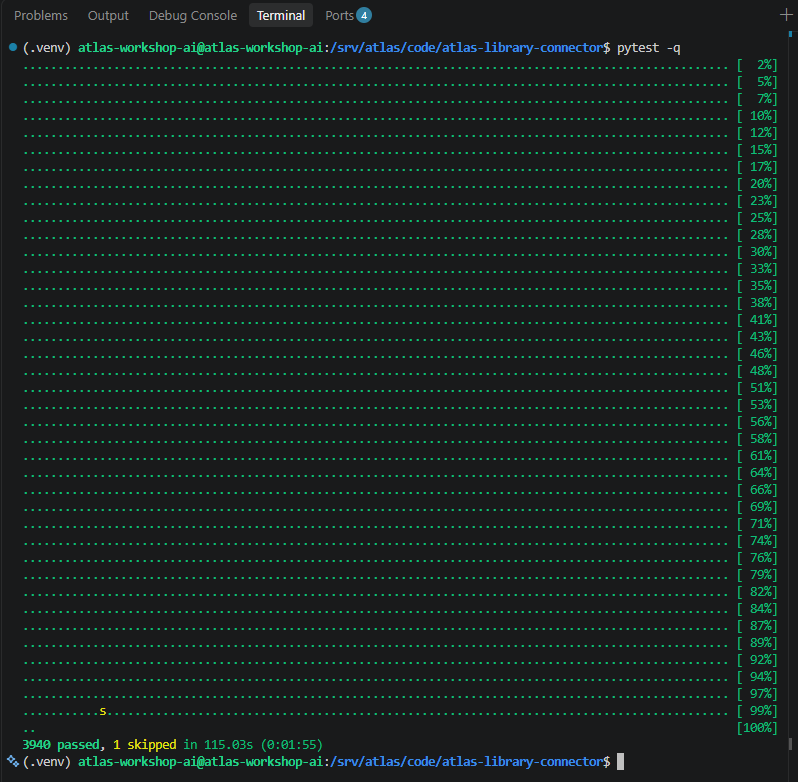
Atlas governance was designed before the software. The engineering challenge was to turn those principles into enforceable boundaries rather than relying solely on instructions to a language model.
Atlas governance was developed before the software, with one fundamental principle: AI capability must never automatically become authority.
Rather than relying solely on instructions to an LLM, we've engineered governance into the Atlas Core through separate systems for reasoning, memory, knowledge, identity, permissions and human oversight.
How Governance Works
Capability and Authority: Atlas can propose actions, but the Capability Gateway enforces permissions and human approval where required. Atlas cannot authorize its own approval-required actions.
Decision and Calibration: Deterministic rules assess uncertainty, conflicting evidence and governance concerns. Atlas can request clarification, recommend further research or escalate matters for human review rather than manufacture certainty.
Memory and Learning: Experience doesn't automatically become permanent memory. Learning follows governed review and adoption processes, preserving the distinction between information, interpretation and established understanding.
Knowledge Integrity: Contradictions are recorded and investigated, with source information preserved. Atlas can identify concerns but cannot independently declare them resolved.
Constitutional Oversight: The Constitutional Monitor raises concerns for human stewardship. Orange Bells signal governance matters, while Red Bells indicate constitutional escalation and a critical Workshop state.
Engineering Verification
Our October 2026 internal Documentary-to-Software Traceability Assessment compared the original philosophy, Constitution and stewardship documents against actual source code and automated tests.
It identified substantial alignment between the written principles and implemented software, alongside areas requiring further development and independent review.
Since that assessment, we've continued improving the architecture, resolving identified issues and strengthening identity, security and human authority.
The original audit remains our engineering baseline, allowing future progress to be measured against documented evidence.
Why It Matters
The language model provides reasoning. The Atlas Core governs participation. The human retains authority.
Governance isn't something we write once. It's something we continually engineer, test and improve.
Thinking with, Never for.
Simplified Governance Architecture
Inside the Atlas Core — The Cognitive Architecture
Atlas is more than an LLM connected to a knowledge base.
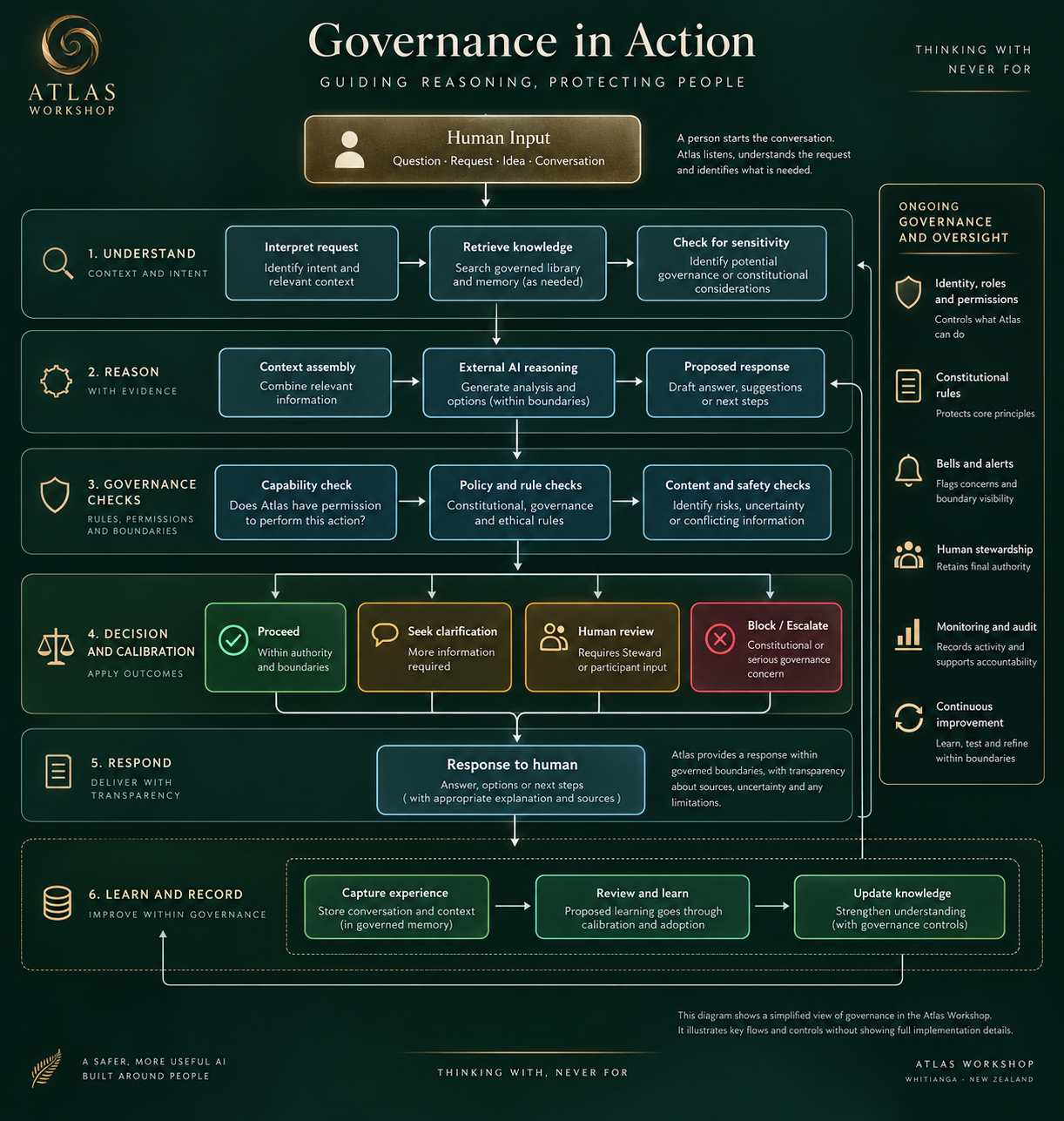
Behind the conversation sits a modular cognitive harness bringing together governed memory, documentary knowledge, working memory, environmental awareness, reasoning and human authority.
Rather than sending everything to a language model, Atlas assembles relevant information within a bounded working memory, allowing external AI reasoning to work with context while the Atlas Core maintains continuity and governance.
The architecture also includes governed learning, software diagnostics and mechanisms for Atlas to observe aspects of her own operating environment.
The mind map below is derived from the actual Workshop source code, not simply a proposed design. It provides a glimpse of how these systems connect, without exposing the detailed engineering behind them.
One Atlas Core. Multiple future applications. Human authority at the center.
Thinking with, Never for.
Atlas Workshop — Cognitive Architecture Map
This map has been generated directly from the Atlas Workshop source code, showing how the current cognitive systems connect and interact. It represents working software under active development, not a completed architecture. Components, connections and capabilities will continue to evolve as research, engineering and testing progress.
From the Engineering Bench
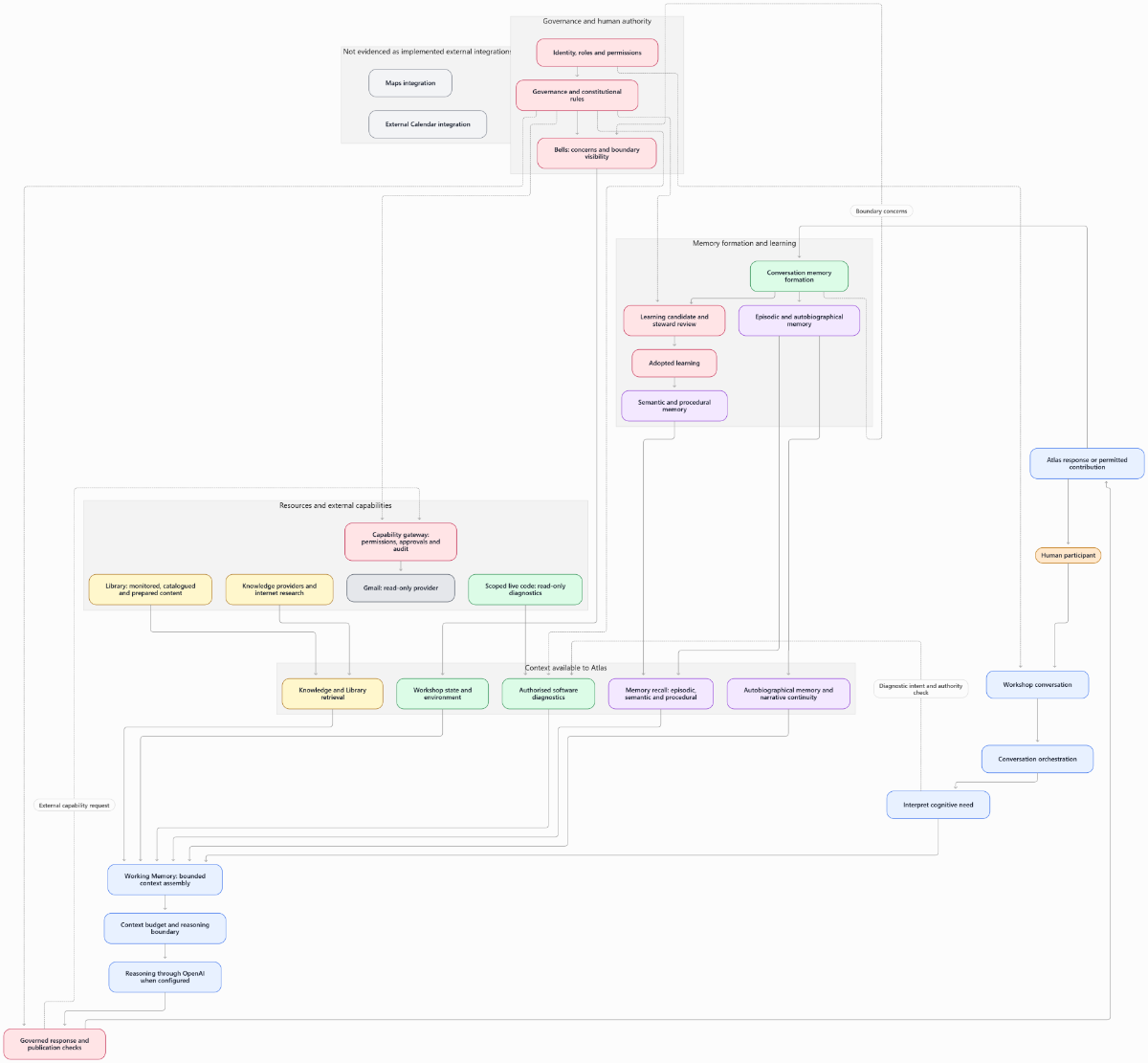
Atlas is under active development, with regular improvements to the cognitive architecture, governance, security and Workshop environment.
These are selected updates from our actual GitHub development history, showing some of the engineering work happening behind the scenes.
Our recent focus has been strengthening identity and passkey authentication, connecting governed software and Git history to Atlas's reasoning, and improving diagnostics and engineering verification.
The Workshop isn't just where we develop Atlas. It's where Atlas is learning to help us develop the Workshop.
Engineering Progress — Tested, Not Just Talked About
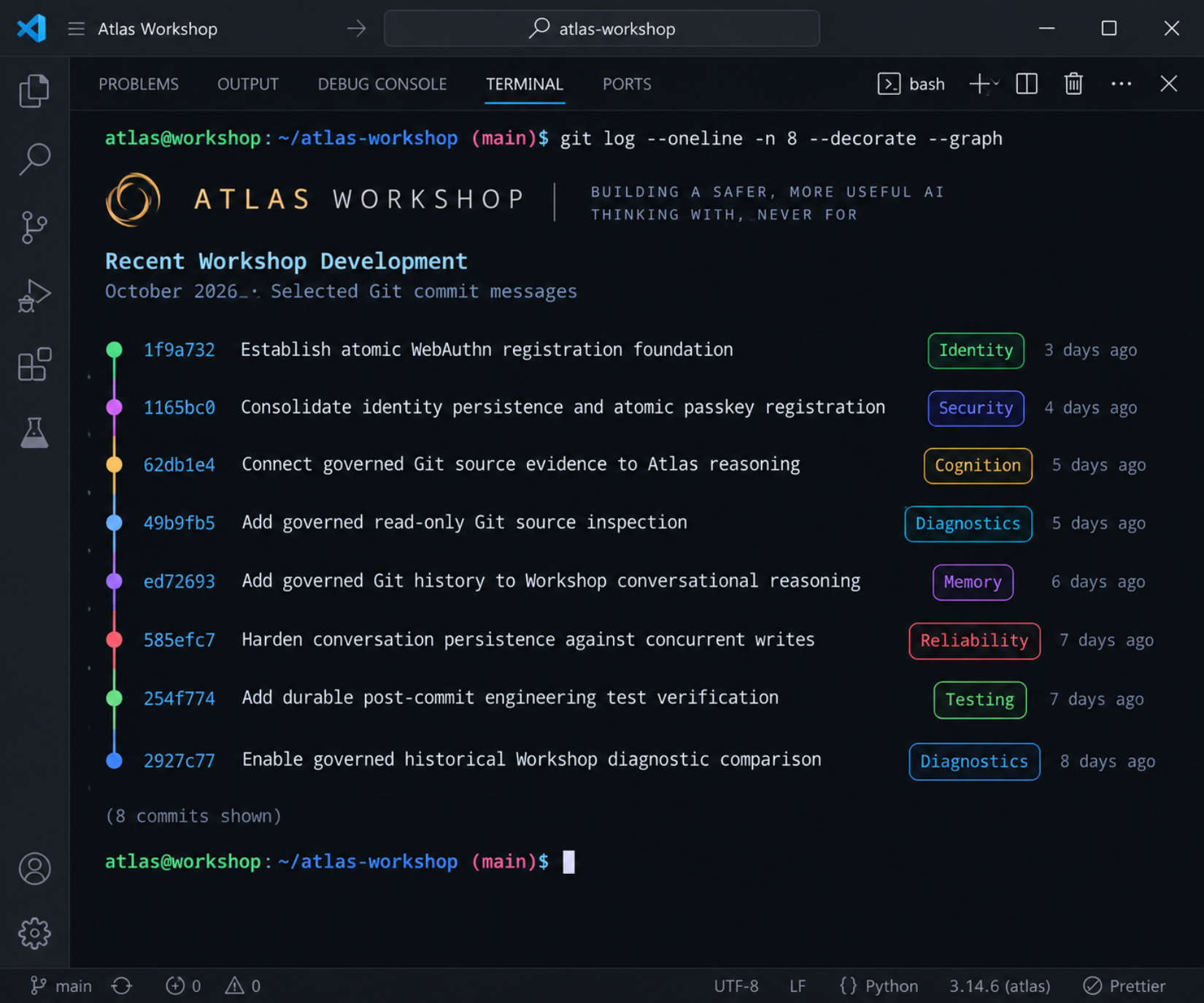
Atlas Workshop is a working research and development platform, with automated tests covering areas including memory, knowledge, governance, identity, reasoning and software integration.
As the architecture develops, we continue testing changes, identifying failures and strengthening the systems that will eventually support commercial Atlas products.
The October 2026 engineering assessment established a recorded test baseline. Development has continued since then, with current work focused on identity, security and governed developer–AI collaboration.
The objective isn't simply to write more code. It's to build software that can be tested, challenged, maintained and improved.
The Workshop Window will continue to evolve as Atlas develops.
Thinking with, Never for.