

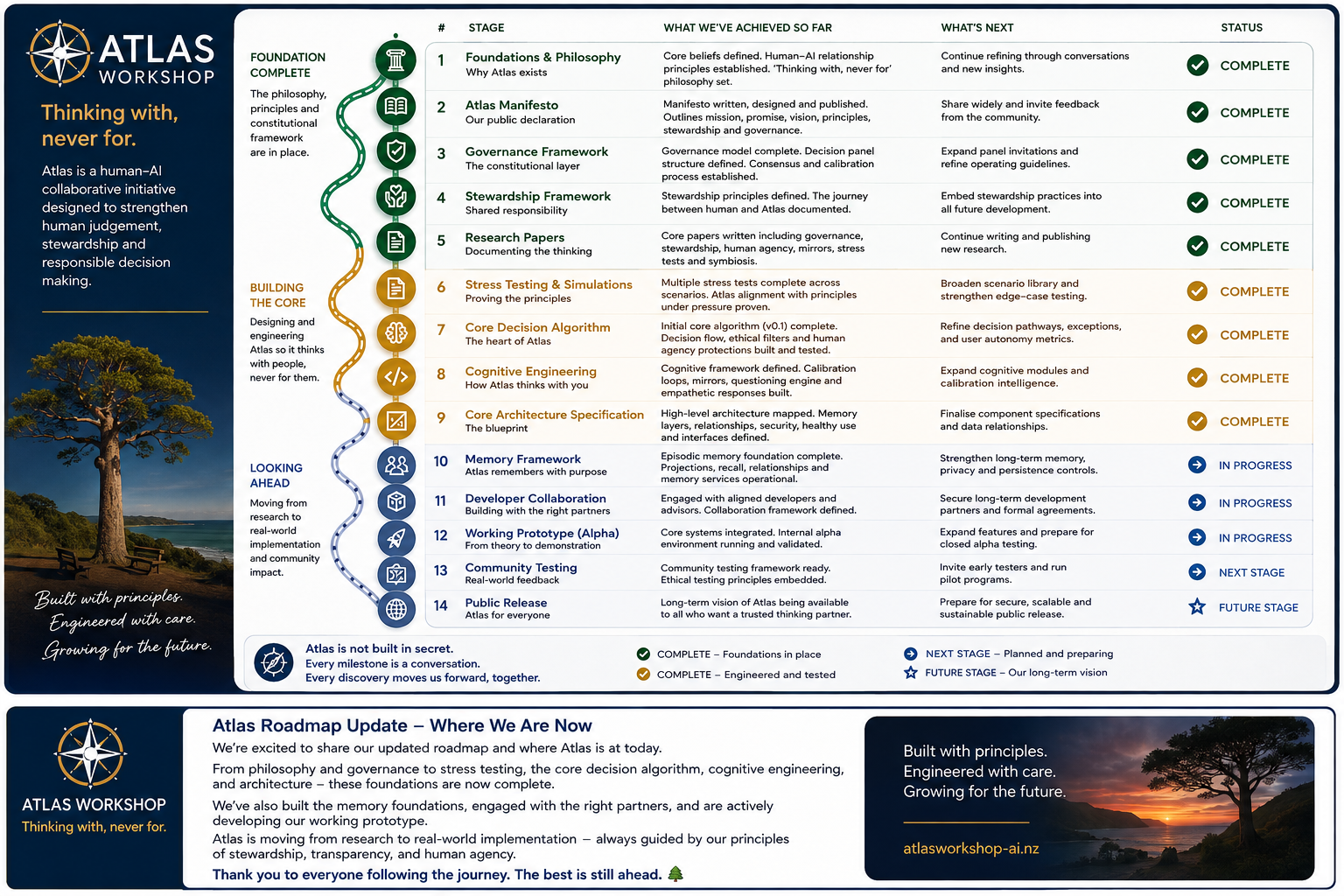
What have we actually built with Atlas?
With the NZ Tech Expo coming up next Friday, I thought it was worth answering that before I get there. Atlas isn't another language model, and we haven't built our own LLM.We've built a governed cognitive architecture around replaceable AI reasoning.The LLM provides reasoning capability. Atlas provides persistent memory, context, continuity, Behaviour, governance and the boundaries around how that reasoning is used. This week we completed another important piece:Governed proactive participation.Atlas can now join a conversation without waiting to be directly asked — without becoming the bloke at the pub who has an opinion on every bloody subject. It first has to recognise that something is worth contributing. Its cognitive footing, Behaviour, Workshop permissions and publication rules determine whether that thought should actually be said. Sometimes the right behaviour is to contribute.Sometimes it's to shut up and listen.Turns out that's useful in humans too. 😂 The boundaries matter:The reasoning model doesn't decide when Atlas speaks.Behaviour doesn't create authority.Memory isn't automatically truth.The human remains the authority.We've now started live stress testing. It immediately found an integration fault that 2,091 passing automated tests hadn't caught.Good. That's what stress testing is for. We fixed the boundary, added the regression test and ran it live again.2,092 passed. 1 skipped.There are products and research projects working on individual pieces of this problem — memory, governance, provenance, agents and human oversight. What I haven't yet found is another product putting those pieces together in quite the same architecture. That's not a claim nobody else can or will. It means Atlas is ready to be tested outside our own Workshop. Next Friday at Shed 10, I'm not interested in showing people AI party tricks. I'd rather put Atlas in front of people who understand technology, business and investment and ask:How would you break it?Find the weak point. Test the assumption. Stress the boundary. That's how we've built Atlas so far.Thinking with, never for.#AtlasWorkshop #ArtificialIntelligence #AIGovernance #HumanAI #NZTech