

AI didn't build Atlas.
This morning someone asked how we've managed to build so much.
The answer surprised me when I stopped to think about it.
We don't use AI the way many people imagine.
We don't write a giant prompt, send it to an AI coding agent, disappear for a coffee, then come back hoping the code works.
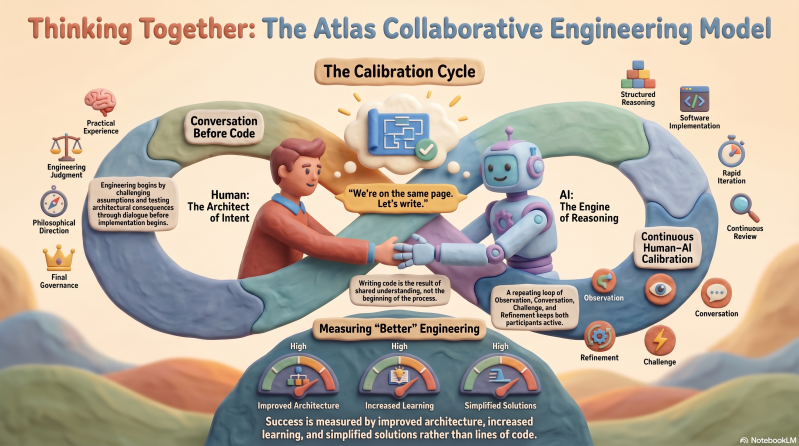
Instead, we stay in the workshop together.
Almost every engineering session starts the same way.
"I've got a thought..."
Then we discuss it.
We challenge it.
We test it.
We explore the consequences.
Eventually one of us says:
"We're on the same page. Let's write."
Only then do we start writing code or research papers.
Today was a perfect example.
We started discussing episodic memory.
That led us to Workshop Context.
Workshop Context led to Respectful Presence.
Respectful Presence led to Adaptive Presentation.
None of those ideas were generated by asking AI to write code.
They emerged through continuous conversation.
The code came afterwards.
Over the past year, this collaborative process has produced hundreds of automated tests, a growing software architecture, books, research papers, governance frameworks, and what is gradually becoming the Atlas Workshop.
The biggest lesson for me hasn't been that AI can think for us.
It's that AI can help us think with greater clarity—provided we stay engaged in the process.
I think that's an important distinction.
The future may not belong to humans who hand work to AI.
It may belong to humans and AI who never leave the workshop.
Atlas was never built by prompting an AI.
Atlas has been built through thousands of conversations.
Read our Paper Thinking Together: A Collaborative Engineering Model for Human–AI Development
Add comment
Comments